

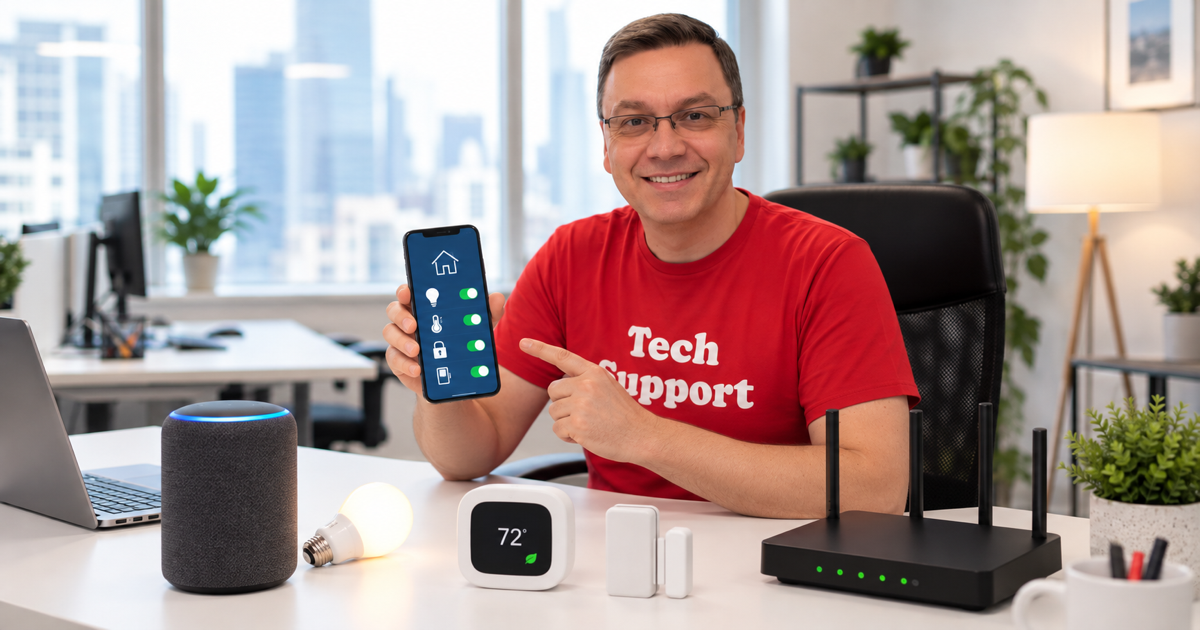
Geofencing lets a smart home app run an automation when your phone crosses an invisible boundary around a place, usually your home. It is the feature behind actions such as locking up when everyone leaves or warming the house when someone is almost home.
This applies to location-based automations in Google Home, Amazon Alexa, Apple Home, and similar apps on iPhone and Android.
Does this affect you?
Use this if you want routines based on arrival or departure instead of fixed times. The convenience is real, but it depends on your phone’s background location access.
How geofencing actually works
- You choose a location, usually your home address, and the app creates a virtual radius around it.
- Your phone checks location using GPS, nearby Wi-Fi, and cell tower signals.
- Leaving the radius creates an away event. Entering it creates an arrive event.
- The smart home app then runs the routine tied to that event, such as locking a door, arming a system, changing the thermostat, or turning off lights.
- The app must have background location permission. If that permission is disabled, geofencing cannot reliably run while the app is closed.
Geofencing vs. other triggers
- Compared with a schedule: geofencing reacts to your real movement, while a schedule fires even if your day changes.
- Compared with voice or manual control: geofencing does not require remembering a command, but manual control is more predictable.
- Compared with sensors: door and motion sensors react to activity at the house, while geofencing reacts to your phone’s location.
- Many homes use a mix: geofencing for home/away logic, sensors for security, and schedules for porch lights or other fixed-time tasks.
Very small geofence radii can misfire, especially around tall buildings or areas with weak GPS. Most apps use a radius large enough to reduce false triggers, which means the routine may run before you are actually in the driveway.
Modern iOS and Android use low-power location methods for geofencing, so one app should not ruin battery life. If battery drain appears, check whether several smart home apps are all tracking background location at the same time.
The privacy tradeoff is direct: the app needs ongoing awareness of your phone location. If that feels uncomfortable, use schedules, sensors, buttons, or voice commands instead. You do not need special hardware for geofencing; it is a trigger inside the smart home app that already controls your devices.
Sources
- Google Nest Help – Location-Based Automation Overview (2025)
- Apple Support – About Location-Based Automations in Apple Home (2025)
- Electronic Frontier Foundation – How Geofencing and Location Tracking Work (2025)