

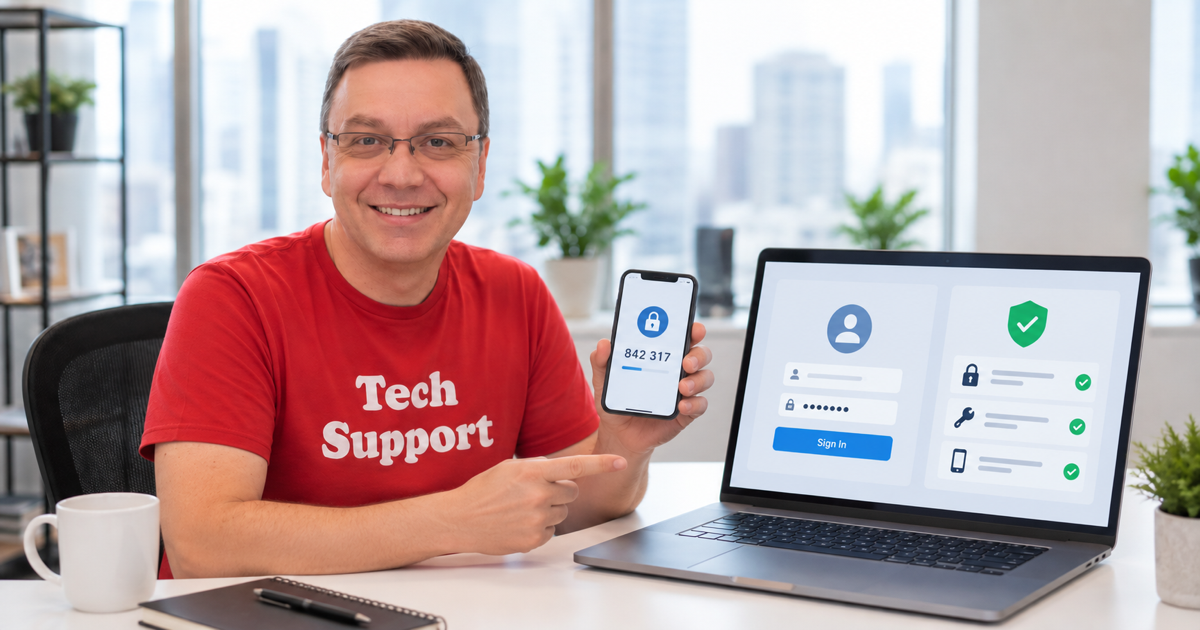
Sign in with Google is convenient and often safer than creating another weak or reused password. The tradeoff is concentration: one Google Account can become the key to many other accounts, so it must be protected well.
Does this affect you?
Use this when an app or website offers Sign in with Google, Apple, Facebook, or Microsoft instead of making a separate username and password, and you are deciding whether to use it.
Why it is a reasonable default for many apps
For lower-risk services, single sign-on can reduce real-world password mistakes.
- You create and remember fewer passwords, which reduces the chance of password reuse.
- If your Google Account has strong two-factor authentication, that protection helps guard every app that relies on Google sign-in.
- If a small app is breached, attackers usually do not get a separate password for that app because one was never stored there.
- App cleanup is simpler. Go to myaccount.google.com > Security > Third-party apps with account access to review and revoke old connections.
Where a separate login is smarter
Use more caution when the stakes are high or long-term access matters.
- For banking, tax filing, health records, government services, and identity-related accounts, use a dedicated login with its own two-factor authentication.
- If you might stop using Google as your main email provider, a separate login can be easier to maintain than an account tied entirely to Google sign-in.
- On shared or work devices, signing in with a personal Google Account can blur boundaries and accidentally expose more than intended.
- For your primary email account itself, do not make every important service depend on a single recovery point if you can avoid it.
More control
Protect Google like a master key
Use a long unique Google password, turn on two-factor authentication, keep recovery email and phone current, and review recent security activity. The convenience is only safe if the central account is strong.
Use it by risk level
Sign in with Google is usually fine for games, newsletters, shopping trials, forums, and low-stakes apps. Use dedicated logins for money, taxes, health, and essential identity accounts.
Revoke apps you no longer use
Connected apps can remain authorized for years. Review Third-party apps with account access every few months and remove services you no longer trust or recognize.
The tradeoff is real
Single sign-on reduces password clutter and breach exposure, but a Google lockout can cascade into apps that depend on it. Balance convenience against how painful losing access would be.
Sources
- Google Safety Center – Sign in with Google (2025)
- FTC – Online account security (2025)
- CISA – Identity and access management (2025)