

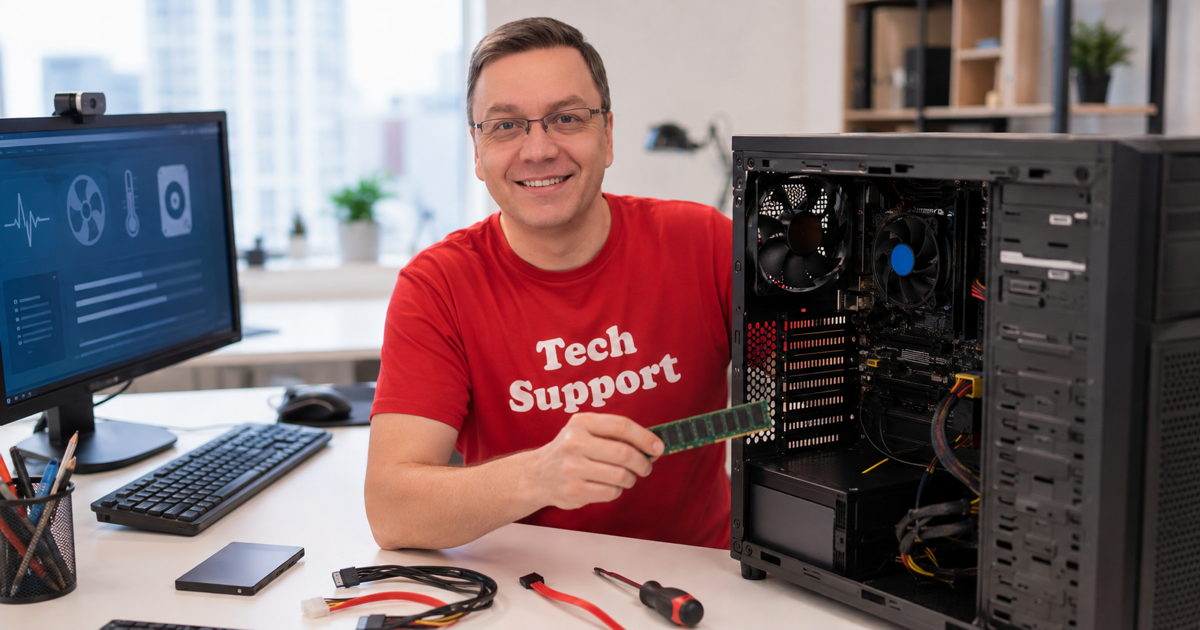
The motherboard is the large circuit board that every major computer part connects to. The CPU, RAM, storage, graphics card, power cables, and external ports all trace back to it. It is not the part doing most of the computing, but nothing else works without it.
Does this affect you?
Understanding the motherboard helps when buying a desktop, checking upgrade compatibility, identifying your PC model, or diagnosing a system that will not power on correctly.
What a motherboard actually does
It is the physical base and communication path for the entire computer.
- It holds the CPU socket, RAM slots, storage connectors, and expansion slots.
- It routes power and data through layers of circuitry so components can communicate.
- It provides or connects external ports such as USB, audio, Ethernet, display outputs, Wi-Fi, and Bluetooth.
- Its chipset determines many feature limits, including ports, storage lanes, overclocking support, and expansion options.
- It stores the BIOS or UEFI firmware that starts the computer before the operating system loads.
What varies between motherboards
Compatibility is the key detail; not every board supports every part.
- The CPU socket must match the CPU brand and generation. Intel and AMD sockets are not interchangeable.
- Form factor controls size. ATX is standard, Micro-ATX is smaller, and Mini-ITX is compact with fewer slots. The case must support the board size.
- RAM type and slots vary. A DDR4 board cannot use DDR5 memory, and boards differ in supported speeds and capacities.
- PCIe slots determine what graphics cards, capture cards, and add-in cards can be installed.
- On Windows, PowerShell can show the baseboard model with Get-CimInstance -ClassName Win32_BaseBoard, or you can use CPU-Z for a friendlier view.
A few things worth knowing
Motherboards are rarely casual upgrades
Replacing a motherboard often means rebuilding much of the PC, possibly buying a new CPU and RAM, and sometimes reactivating or reinstalling Windows. Storage and RAM are usually easier upgrades.
Laptop motherboards are different
Laptop boards are custom for each model and often have soldered CPUs. Replacement is usually a repair, not an upgrade, and may not be cost-effective.
A dead motherboard diagnosis is easy to get wrong
No-power symptoms can come from the PSU, loose cables, RAM, case power button, or shorted accessories. Rule out simpler causes before assuming the motherboard failed.
Sources
- Intel – What Is a Motherboard? (2025)
- ASUS – Motherboard Basics Explained (2025)
- Micro Center – Choosing the Right Motherboard (2024)