

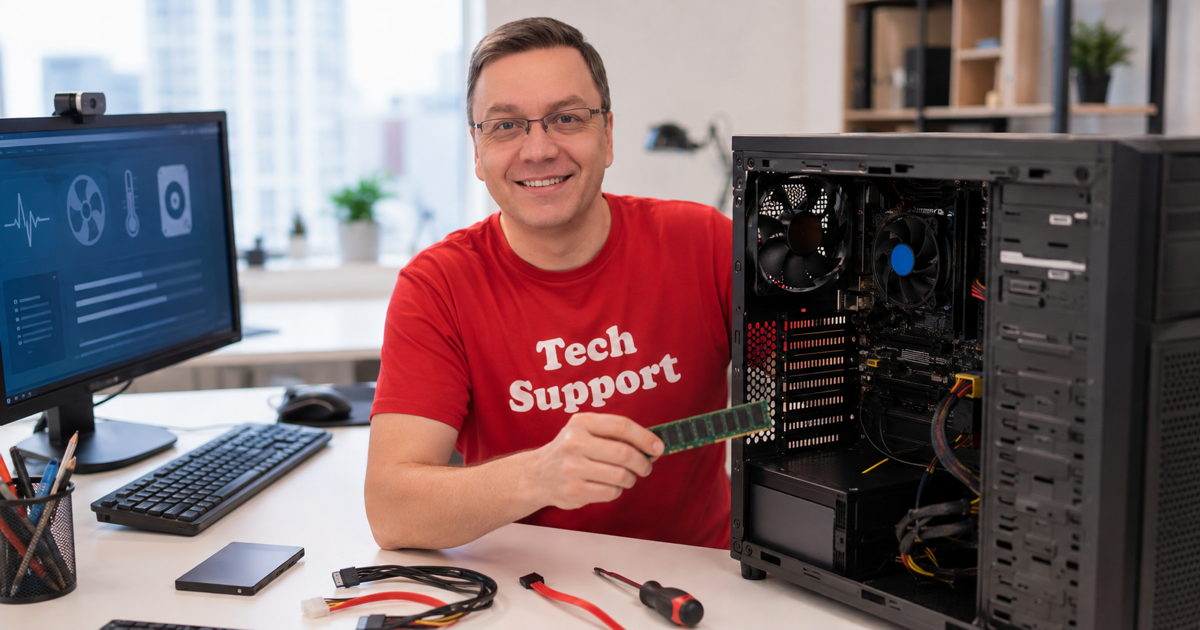
Your desktop case feels hot, fans stay loud, performance drops, or the system shuts down under gaming, rendering, or other load. This applies to air-cooled and liquid-cooled desktop PCs.
Does This Affect You?
Desktops have more cooling room than laptops, so overheating often comes from blocked airflow, dust-clogged heatsinks, stopped fans, dried thermal paste, weak fan curves, or an undersized cooler.
Check Airflow and Confirm It Is Overheating
Verify temperatures before taking the PC apart.
- Give the case several inches of open space and avoid closed desk cabinets.
- Look through vents or the side panel to confirm case, CPU, GPU, and radiator fans are spinning under load.
- Use HWiNFO or HWMonitor to watch CPU and GPU temperatures during normal use and load. CPU temperatures in the mid-to-high 90C range or GPU temperatures above roughly 85C can cause throttling or shutdowns.
- Check front, bottom, and PSU dust filters for visible clogging.
Before opening the case, shut down, unplug power, ground yourself, avoid vacuuming components, and hold fan blades still when using compressed air. These steps are at your own risk.
Clean Dust and Reapply Thermal Paste
This fixes many hot desktop PCs.
- Open the side panels.
- Use compressed air on dust filters, case fans, the power-supply vent, CPU heatsink fins, radiator fins, and the graphics card heatsink.
- Wash removable dust filters only if the case manual allows it, and let them dry fully before reinstalling.
- If the PC is more than a few years old, remove the CPU cooler according to its instructions, clean old paste with isopropyl alcohol and a lint-free cloth, and apply a pea-sized dot of new thermal paste before remounting evenly.
- Close the case and retest temperatures under load.
If temperatures remain high, adjust fan curves in BIOS or motherboard software. This changes fan speed versus temperature and is reversible, but avoid voltage and overclocking changes. Check airflow direction too: front and bottom intake, rear and top exhaust is a common layout.
A case with too few fans or a stock CPU cooler on a hotter processor may need better cooling hardware. Adding case fans or a larger CPU cooler is often cheaper than replacing major components.
Sources
- Intel – Understanding CPU Thermal Throttling (2024)
- Corsair – How to Properly Clean Dust From Your PC (2025)
- Noctua – Guide to Applying Thermal Paste (2024)