

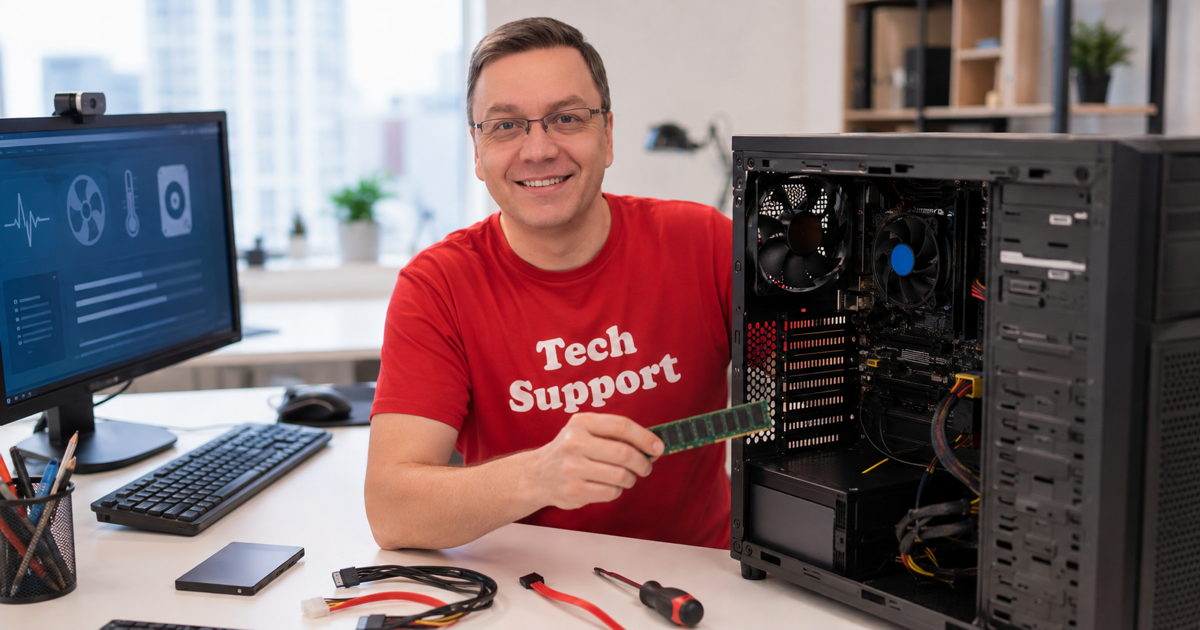
Your desktop powers on, fans spin, and lights come on, but it never reaches Windows or the display stays black. If there are no lights or fans at all, use a no-power guide instead.
Does This Affect You?
A PC that powers on but does not boot is failing somewhere between POST and Windows loading. Common causes include RAM that is not seated, a boot device problem, a wrong boot order, a connected USB drive, or a corrupted BIOS setting.
Listen for Beep Codes and Check the Monitor
Do this before opening the case.
- Listen immediately after pressing power. One short beep is often normal; repeated patterns point to a hardware fault.
- Check the motherboard manual for the exact beep-code meaning.
- Confirm the monitor is on, set to the correct input, and connected firmly.
- Disconnect USB drives, external drives, and discs that may be stealing boot priority.
Reseat the RAM
Loose RAM is one of the most common no-boot causes.
Shut the PC down, unplug it, and ground yourself before touching internal parts. Handle RAM by its edges. These steps are at your own risk.
- Open the side panel and locate the RAM slots near the CPU.
- Push the side clips outward and remove each RAM stick.
- If contacts look dirty, clean gently with a soft eraser and remove residue.
- Press the RAM back in until both clips click.
- If there are multiple sticks, test one stick at a time and try different slots.
- Reconnect power and test booting.
Check the Boot Order in BIOS
Use this if the PC reaches BIOS or a boot error but not Windows.
Changing boot order is reversible. Avoid unrelated BIOS settings. We provide no warranty; proceed at your own risk.
- Restart and enter BIOS/UEFI with Delete, F2, F10, or the key shown on screen.
- Open the Boot section.
- Put the main Windows SSD or hard drive first, ahead of USB and network boot.
- If the drive is missing, check its SATA power/data cables or M.2 seating.
- Save and exit.
If Windows begins loading and fails, force interruption three times during boot to reach Automatic Repair, then try Startup Repair or System Restore. If RAM, cables, boot order, and CMOS reset do not help, motherboard, CPU, PSU, or drive failure may need shop-level diagnosis.
Sources
- Intel Support – Troubleshooting a computer that will not boot (2025)
- Microsoft Support – Advanced startup options in Windows (2025)
- Crucial – How to reseat RAM troubleshooting guide (2024)