

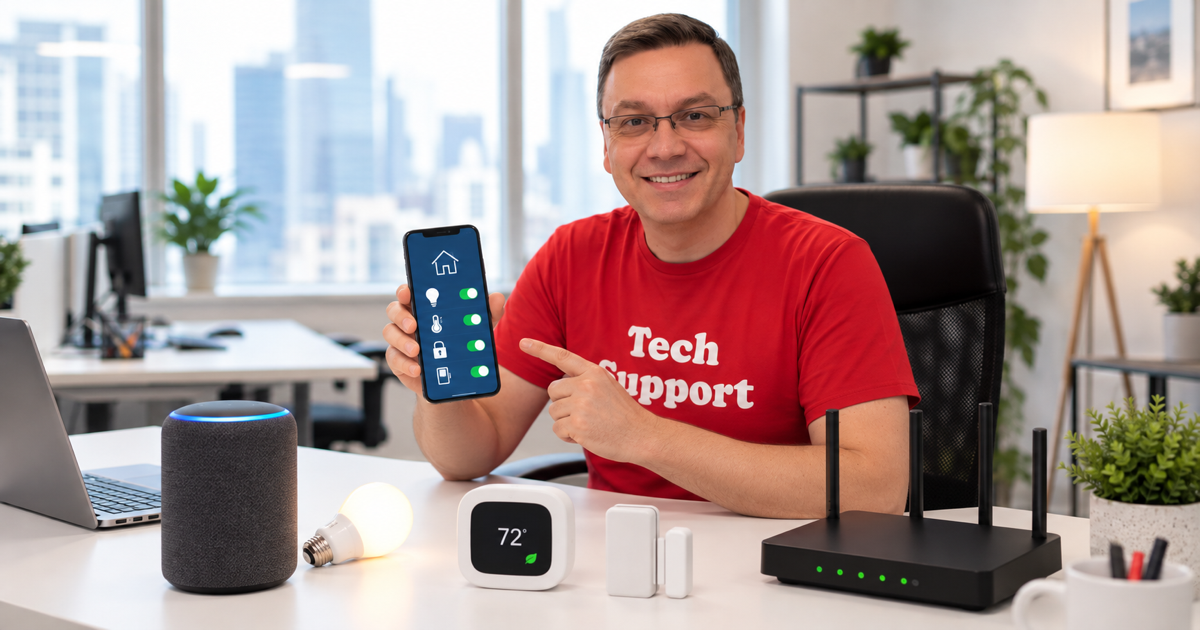
A smart home ecosystem is the app, voice assistant, and sometimes hub that ties your devices together. It is the reason a bulb may work in Alexa but not Apple Home, or a camera may show in Google Home but not on an Echo Show.
This guide is for anyone starting a smart home or trying to understand why products from different brands do not always appear in the same app.
Does this affect you?
If you want lights, locks, cameras, sensors, thermostats, and speakers to work together, ecosystem choice matters. A device usually must explicitly support your chosen app before it can be added and controlled there.
Why ecosystems exist in the first place
Smart home platforms grew separately before a common standard became widely available, so compatibility has historically been fragmented.
- Amazon Alexa, Google Home, Apple Home, and Samsung SmartThings each developed their own pairing flow, app controls, voice commands, and certification rules.
- A product labeled Works with Alexa does not automatically work with Apple Home or Google Home unless the manufacturer built and certified that support too.
- This creates a walled-garden effect. The device may be technically capable, but the app will not expose features unless the ecosystem supports it.
- For shoppers, the practical rule is simple: check the exact compatibility list for the exact model before buying, not only the brand name.
The major ecosystems, briefly
Each platform can run a useful smart home, but they fit different households.
- Amazon Alexa: Broad third-party device support, strong Echo speaker and Echo Show integration, and equal availability on iPhone and Android.
- Google Home: Good smart device support, tight links to Android, Google Assistant, Calendar, Photos, Nest devices, and Nest displays.
- Apple Home: Smaller historical device selection but deep iPhone integration, Control Center access, and a stronger privacy-focused positioning.
- Samsung SmartThings: Broad device and hub support with more flexibility for people who want multi-brand automations and deeper customization.
- Home Assistant: A self-hosted open-source option for advanced users who want more local control and less dependence on one company’s cloud.
Matter is changing this. A Matter-certified device is designed to work across major ecosystems such as Alexa, Google Home, Apple Home, and SmartThings. You still choose a main app and voice assistant, but Matter reduces the old problem of buying a device that only works with one platform.
You can run more than one ecosystem in the same home. Many people have an Echo in one room and an Apple TV or Nest Hub elsewhere. The catch is routines: automations usually run best inside one ecosystem unless Matter, SmartThings, or Home Assistant bridges the devices together.
Switching ecosystems later is possible but inconvenient. Devices usually need to be removed and re-added manually, and routines must be rebuilt. There is no universal one-click migration between the major platforms.
Do not assume every device from a brand supports the same ecosystems. One camera, lock, or sensor line may support Apple Home while another line from the same company does not.
Sources
- Consumer Reports – Understanding Smart Home Ecosystems (2025)
- Connectivity Standards Alliance – Matter and Ecosystem Interoperability (2025)
- Google – Google Home App and Compatible Devices (2025)