

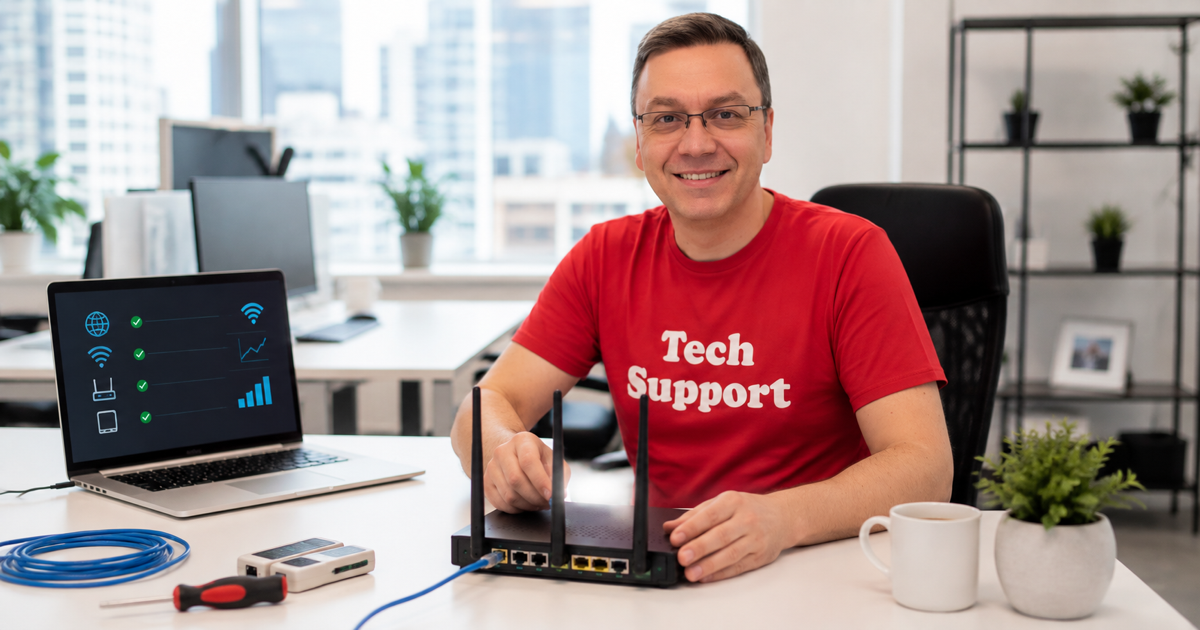
A Wi-Fi extender repeats your existing router signal into a weak area. It is a low-cost fix for one dead zone, but placement matters as much as the setup itself.
Does this affect you?
Use this for most plug-in Wi-Fi extenders and range boosters from Netgear, TP-Link, Linksys, and similar brands.
Set it up with WPS
WPS is the fastest method when both router and extender support it.
- Plug the extender into an outlet close to the router for initial setup.
- Wait for the extender power light to become solid.
- Press the WPS button on the router.
- Within about two minutes, press WPS on the extender.
- Watch for a success light, often solid or green. Blinking or amber usually means pairing failed.
- Move the extender to its final outlet, roughly halfway between the router and weak area.
Set it up with an app or browser
Use this when WPS is unavailable or fails.
- Plug the extender in near the router and let it boot.
- Connect a phone or laptop to the extender temporary Wi-Fi name, often printed on its label.
- Open the companion app or the setup address printed on the extender, such as mywifiext.net or 192.168.1.250.
- Choose your main home Wi-Fi network from the list.
- Enter the home Wi-Fi password.
- Choose whether the extender should use the same network name or its own name.
- Finish setup, reconnect to normal Wi-Fi, and move the extender to the target area.
Place it correctly
A badly placed extender can look connected while barely helping.
- Do not plug it inside the dead zone. It needs a usable signal from the router to repeat.
- Aim for the midpoint between the router and weak room.
- Use the extender signal indicator and move it closer to the router if the backhaul signal is weak.
- Avoid cabinets, behind-TV outlets, and large metal appliances.
- Run a quick speed test in the weak area before and after placement.
More control
Older extenders can cut speed
Single-band extenders often receive and rebroadcast on the same channel, reducing available speed. Dual-band or tri-band models handle this better.
Mesh is better for several dead zones
If the whole house has coverage problems, a mesh system usually gives smoother roaming and steadier coverage than several standalone extenders.
Same SSID is convenient but not perfect
Using the same Wi-Fi name and password allows easier roaming, but some devices cling to the weaker signal. A separate extender name gives more manual control.
Sources
- Netgear Support – Set up your Wi-Fi range extender (2025)
- TP-Link Support – How to set up a Wi-Fi extender (2025)
- FCC Consumer Guide – Wireless Network Troubleshooting (2024)