

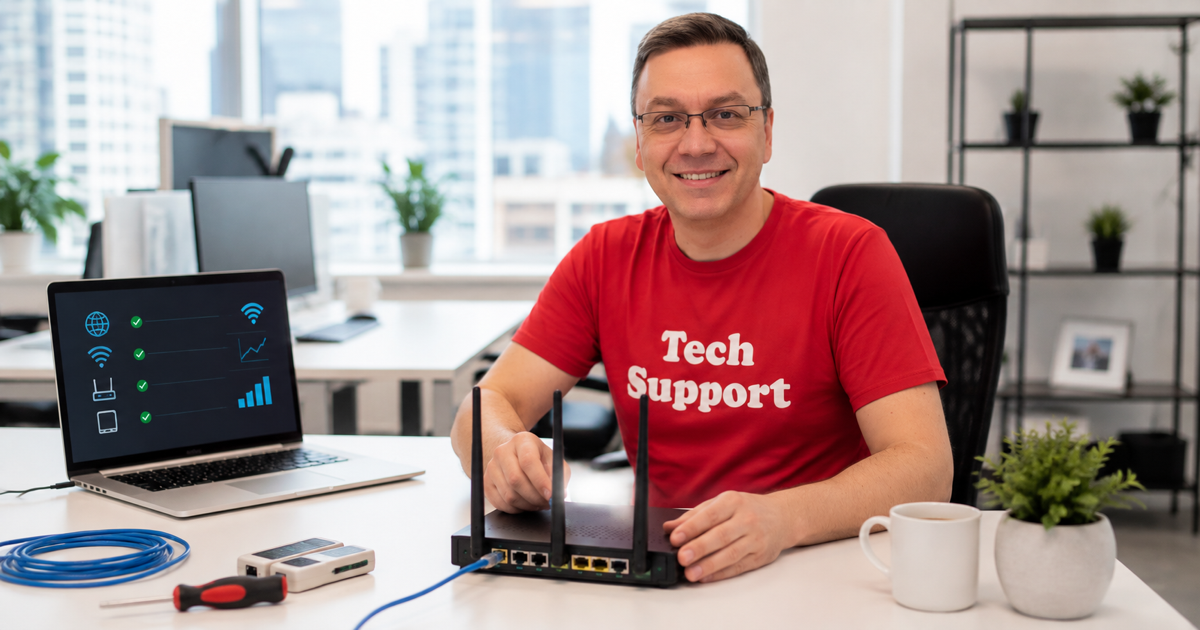
A home network is easier to build when you follow the right order: get the internet line online, connect the router, create secure Wi-Fi, then add devices. Most setup confusion comes from skipping ahead.
Does this affect you?
Use this after moving, switching providers, buying new router equipment, replacing a modem, or setting up cable, fiber, or DSL service from scratch.
Set up your network in order
Each step depends on the previous one working.
- Connect the modem first. Plug it into the cable, fiber, or DSL outlet and power it on. Wait for online or internet lights to become solid.
- Connect the router to the modem with Ethernet, using the router WAN or Internet port. Skip this if you have a combined modem/router gateway.
- Power on the router and wait for status lights to settle.
- Connect a phone or laptop to the default Wi-Fi name printed on the router label.
- Open the router setup app or web page, often shown on the box, label, or quick-start card. Older routers often use 192.168.1.1.
- Set your own Wi-Fi name and password.
- Change the router admin password from the default.
- Enable a guest network if available for visitors and less-trusted smart devices.
- Connect wired devices such as desktops, TVs, and consoles to LAN ports.
- Connect phones, laptops, printers, and smart home devices over Wi-Fi.
- Run a speed test from a good location and compare it with the plan speed.
More control
Plan coverage early
Homes above roughly 1,500 to 2,000 square feet, multiple floors, basements, or thick walls may need mesh nodes or wired access points from the start.
Wire stationary devices when practical
Desktops, smart TVs, consoles, and access points benefit from Ethernet because speed is steadier and wireless interference is avoided.
Save the new credentials
Store the Wi-Fi password and router admin password somewhere reliable. Future device setup and resets are much easier when you can find them.
Update firmware during setup
Routers often ship with older firmware. Install updates early so security fixes and stability patches are in place before the network becomes busy.
Sources
- FCC – Types of Broadband Connections (2025)
- Wi-Fi Alliance – Wireless Network Basics (2025)
- Netgear Support – Setting Up a Home Network (2025)