

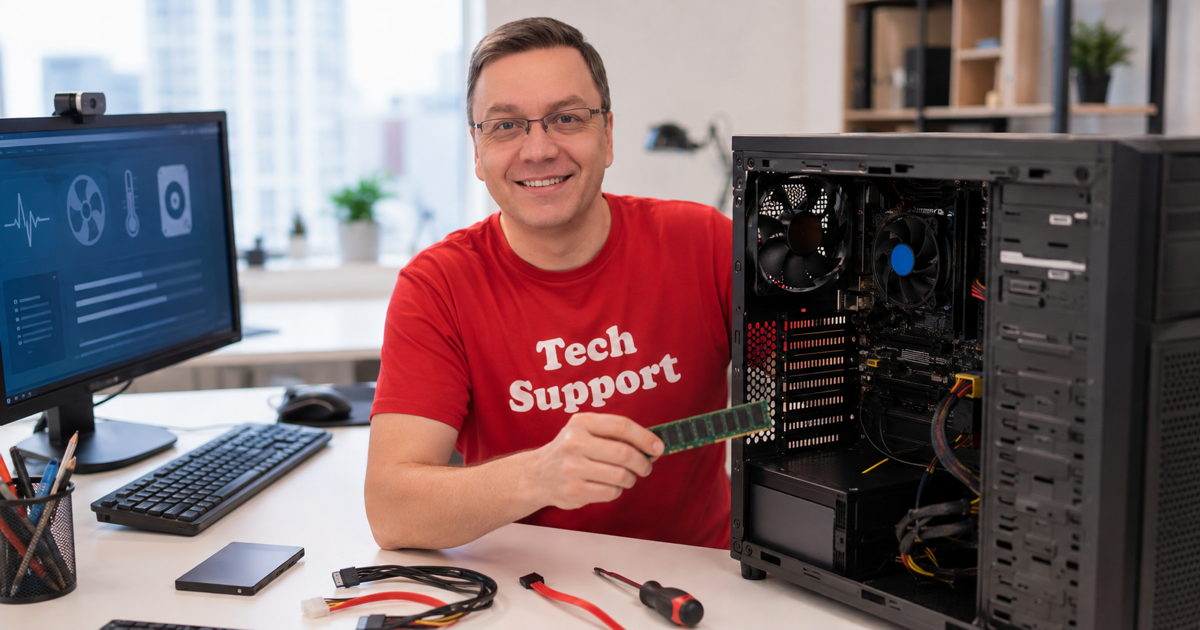
Your desktop PC will not start normally and makes a pattern of beeps instead: one long beep, several short beeps, or repeated groups. This applies to desktop motherboards with BIOS or UEFI beep speakers.
Does This Affect You?
Before Windows loads, the motherboard runs POST, or Power-On Self-Test. If the system cannot show an error on screen, it may beep a code through the motherboard speaker. The pattern points toward the part that failed early, commonly RAM or graphics.
Count and Identify Your Beep Pattern
Beep meanings vary by BIOS maker and motherboard model, so use these as a starting point and then confirm in the manual.
- Restart and count the exact pattern, including pauses between groups.
- AMI BIOS often uses short beep counts: 1 can indicate memory refresh trouble, 2 parity error, 3 base memory failure, 4 timer failure, 8 display memory or graphics failure, and 9 BIOS ROM checksum error.
- Award/Phoenix-style long and short patterns often use 1 long beep for memory trouble, 1 long plus 2 short for video card trouble, and repeating beeps for RAM or graphics not seated well.
- Phoenix BIOS can use grouped sequences such as 1-3-1, so look up the exact grouped code instead of matching it to long/short charts.
- Dell systems use their own patterns; for example several models map 2, 4, or 6 beeps to memory, configuration, or graphics faults.
Once the pattern points at RAM or graphics, the next step is reseating those parts. Shut down, unplug the PC, ground yourself, and handle RAM and graphics cards by the edges only. These steps are at your own risk; contact support if the system is under warranty.
Reseat Memory and the Graphics Card
A loose connection causes many beep-code failures.
- Open the side panel with the PC unplugged.
- Release each RAM stick, remove it, and press it back into the slot until both clips click.
- If there is more than one RAM stick, try booting with one stick at a time to identify a bad module.
- If the PC has a dedicated graphics card, release the PCIe latch, remove the card, reseat it firmly, and reconnect any power cables.
- Close the case, reconnect power, and test startup again.
If reseating does not help, clear CMOS using the motherboard manual. That resets BIOS settings, including boot order and overclocks, but does not erase files. If the same beep code remains after reseating and CMOS reset, the indicated RAM stick, graphics card, or motherboard may need replacement.
Sources
- Dell – BIOS Beep Codes (2025)
- American Megatrends – BIOS POST Beep Codes (2024)
- HP Support – Computer Beeps During Startup (2025)